Be careful with your investments. With the need of quick results, short-term powerful strategies are ta small business owner’s only option. Affordability is the deal-breaker.
The problem is most of the solutions are just fancy and don’t really deliver.
What makes chatbots different? Chatbots refer to bots that can interact with humans. With the emergence of machine learning technologies, these have become self-learning and smart bots that can solve business problems.
For restaurants, chatbots can be deployed at several places - website, social media, & in-restaurant app.
Note - Due to the relevance, we’re only discussing AI powered chatbots and not robotic chatbots, as for a small business, the former technologies are most affordable and beneficial.
1.Manage reservations & take orders
How much time do your employees spend on managing reservations & taking orders? With several online food ordering apps you may have partnered with, it takes a lot of time to take, process and complete an order.
A chatbot, deployed on your website, app, social media - Facebook, Twitter, and even your phone system, can interact with your customers and can perform these monotonous tasks with 100% accuracy.
As restaurants are primarily service based businesses, minimizing errors help you reduce loss of customers & business and avoid mismanagement issues.
2. Promote Deals & Offers
A chatbot can tap into your email list and entice your existing customers with new deals and offers. They can work on social media and even, on your website and bring in a lot of repeat business.
With machine learning, chatbots for restaurants can easily recognize your regular customers and bring them back for more business through automated deals and offers sent to them via emails or Facebook messenger or SMS reminders.
3. Present Your Menu in A Better Way
Any restaurant that has a big menu faces the problem of having some really good dishes ignored by customers. The solution is either each of your employees is trained to know the menu thoroughly and give on-spot recommendations or have a chatbot that can not only present your menu in a visually attractive & conversational way but also learn about your customer preferences to offer better recommendations.
4. Food Recommendations
The current generation prefers personalization and expects you to understand their choices better. Several businesses have had complaining reviews on Yelp for their staff couldn’t help to point out the vegan choices in a menu.
Most of the recommendations by your employees are based on what’s popular in your restaurant but for a customer, what they would like or dislike matters more. What beverage would be better with their existing order? What type of curry would go with the bread they just chose?
Either you hire employees who are adept at such recommendations with thorough knowledge of your menu, which obviously would be way too expensive or you deploy a chatbot that can do this for you for forever with zero downtime.
5. Connect With Your Customers Better
Whether the customer is online or sitting already in your diner, chatbots for restaurants are able to engage better, reducing the need for additional manpower and improving customer experience. Recommendations, taking orders, offering deals and answering FAQs can all be done through a fun, DIY, and conversational interface.
6. Follow Up On Feedback
For every restaurant, reviews on websites like Yelp bring in additional business. But how do you follow up with each customer that enters your restaurant to leave you a review? It’s time-consuming and expensive.
Chatbots can automatically send reminders to your customers to leave you feedback. In fact, if you are opting for a chatbot with multiple features, you probably already had your customer fill in his details and give you permission to email them.
With no human intervention, you have a better system to take reviews and feedback of customers via machine learning chatbots.
7. Easier Delivery & Takeaway
If your restaurant offers delivery & takeaway services, you can reduce the effort it takes for a customer to place such an order. They don’t even have to call you or switch to an app to place an order. They can message you just on Facebook or on your website’s chat window and place an order, while having a highly engaging conversation with the chatbot.
8. POS system on chat
Chatbots can be well integrated with major POS systems so that your customer can not only place order but also complete payment through the same interface.
9. Loyalty Program
Automating your loyalty program, encouraging people to buy more from you without acting all sales-y all the time is another useful application of chatbots for restaurants.
Take a moment and calculate how much money you would have to spend if you had to hire employees for all these tasks per year? Now, just think if the chatbot brings in even 1% of repeat business, how much more money would you make? Add that amount and give us a call for a machine learning chatbot consultation. We bet you will be able to have a chatbot developed for you in lesser cost than what you just calculated.
We understand how small businesses run on tight budgets so you can even start with one feature and keep adding. With each additional feature in the chatbot, you’ll be able to save more money and run your business better.
That’s how powerful chatbots for restaurants are. They’re not just another technology everybody is talking about. According to a 2016 business insider report, by 2022, 80% of businesses will be using chatbots. They’re good for business.

Showing posts with label restaurant. Show all posts
Showing posts with label restaurant. Show all posts
Thursday, 10 October 2019

Tuesday, 8 October 2019
Key factors for the perfect restaurant service
A perfect restaurant service is when the customer leaves the establishment completely satisfied. How often does this happen at your restaurant? The truth is that making our entire service run smoothly every day is a difficult—but not impossible—challenge. A supplier can fail to deliver one day and affect the briefing, and on a different day, a waiter can become sick or product can become damaged. However, the important thing is for customers to have a great experience in spite of unforeseen events.
Let’s start with an initial exercise where you put yourself in your customer’s shoes, which is something we suggest that you always do:
Enter your restaurant as if it were any other one and think about what would be your minimum service expectations and write them down. You would surely expect something like the following:
You would be greeted with a warm hello upon entering.
Quick service to seat you at a table.
An appropriate and convenient location.
The smell, temperature, music, and lighting of the establishment must be comfortable or at least not bothersome.
You quickly receive the menu.
The prices are accurate.
The waiter properly explains the food selection and helps you make a purchase decision.
The waiter gives you time to choose.
You have all the basic utensils without having to ask for them (napkins, silverware, bread, water, etc.).
Drinks are served to you in a timely manner.
They quickly take your order.
There is free Wi-Fi.
The food arrives on time, at the proper temperature, in the advertised portions, and is delicious and hearty.
Dishes are more or less brought at the same pace.
Restrooms are easily accessible, clean, and have all the amenities.
General hygiene conditions are also satisfactory.
Staff is always responsive to your needs.
You can finish your meal without feeling pressured.
The bill is brought to you on time and there are various payment options.
The farewell is equally cordial and without delays.
It is an exercise that lets you familiarize yourself with the most basic service characteristics that your restaurant offers and the measures needed to deliver them on a daily basis. With this starting point, you will have already made a lot of progress at your restaurant.
Second, it is ideal to define at least 3 more types of services so that you can be ready to satisfy different types of customers.
Service protocol for families with children:
– Have special chairs
– Have a menu that is tailored to them.
– The waiters must be extra patient and provide special treatment for these cases.
– Prioritize the children’s food in the kitchen.
– Your kitchen should be flexible with changes to dishes.
Service for large groups:
– A waiter should be particularly attentive to their needs since there are more people than usual.
– Determine the leader of the group so that they can be served in a more orderly manner.
– Have shareable dishes.
– The kitchen should be ready to timely fulfill the order.
– Offer the option of splitting the check.
And do the same with other types of customers such as couples, millennial friends, birthdays, etc. Naturally, this will depend on your restaurant’s characteristics, but it will always important to define the service steps according to each type of customer.
In a nutshell, the perfect restaurant service depends on the number of specifics that are taken into account and can be undertaken. Restaurants that establish protocols and follow them over the long term will definitely achieve the greatest success. We hope that this is the case with your restaurant as well.
Article Source: https://www.theforkmanager.com/au/blog/restaurant-service-perfect/
Let’s start with an initial exercise where you put yourself in your customer’s shoes, which is something we suggest that you always do:
Enter your restaurant as if it were any other one and think about what would be your minimum service expectations and write them down. You would surely expect something like the following:
You would be greeted with a warm hello upon entering.
Quick service to seat you at a table.
An appropriate and convenient location.
The smell, temperature, music, and lighting of the establishment must be comfortable or at least not bothersome.
You quickly receive the menu.
The prices are accurate.
The waiter properly explains the food selection and helps you make a purchase decision.
The waiter gives you time to choose.
You have all the basic utensils without having to ask for them (napkins, silverware, bread, water, etc.).
Drinks are served to you in a timely manner.
They quickly take your order.
There is free Wi-Fi.
The food arrives on time, at the proper temperature, in the advertised portions, and is delicious and hearty.
Dishes are more or less brought at the same pace.
Restrooms are easily accessible, clean, and have all the amenities.
General hygiene conditions are also satisfactory.
Staff is always responsive to your needs.
You can finish your meal without feeling pressured.
The bill is brought to you on time and there are various payment options.
The farewell is equally cordial and without delays.
It is an exercise that lets you familiarize yourself with the most basic service characteristics that your restaurant offers and the measures needed to deliver them on a daily basis. With this starting point, you will have already made a lot of progress at your restaurant.
Second, it is ideal to define at least 3 more types of services so that you can be ready to satisfy different types of customers.
Service protocol for families with children:
– Have special chairs
– Have a menu that is tailored to them.
– The waiters must be extra patient and provide special treatment for these cases.
– Prioritize the children’s food in the kitchen.
– Your kitchen should be flexible with changes to dishes.
Service for large groups:
– A waiter should be particularly attentive to their needs since there are more people than usual.
– Determine the leader of the group so that they can be served in a more orderly manner.
– Have shareable dishes.
– The kitchen should be ready to timely fulfill the order.
– Offer the option of splitting the check.
And do the same with other types of customers such as couples, millennial friends, birthdays, etc. Naturally, this will depend on your restaurant’s characteristics, but it will always important to define the service steps according to each type of customer.
In a nutshell, the perfect restaurant service depends on the number of specifics that are taken into account and can be undertaken. Restaurants that establish protocols and follow them over the long term will definitely achieve the greatest success. We hope that this is the case with your restaurant as well.
Article Source: https://www.theforkmanager.com/au/blog/restaurant-service-perfect/
Friday, 4 October 2019
Ryan Dillinger: How to Make Blogging a Restaurant Promotion Tool
Owning a restaurant is not sufficient, it is essential to have optimum promotion for letting more people know about your restaurant. Blogging is one of the best ways that can be used for letting the targeted audiences know about the restaurant.
Blogs are emerging everywhere on internet with the basic motive of attracting the target audience. Blogs are the content marketing tools that are considered to be an ideal vehicle for promoting your restaurant business. Blogs can give the readers or targeted audiences to interact with the restaurant owners by means of publishing the reply posts below blog entry. Though almost all restaurants have their websites but these websites are hardly utilized. These websites have certain common topics such as menu, private or group bookings, capacity, ambiance of restaurant; there is no interaction amongst the audiences and restaurant owners.
In such cases, blogging is considered effective and a more personalized form of communicating with the people. Blogging has become one of the most popular tools that are used widely by those involved in the restaurant business. There are numerous blogs by waiters, chefs and also by the restaurant customers. The restaurant website can be made more interactive with the regularly updated restaurant blogs. With the blogs that are updated frequently can help in making the website used in a better way and at the same time interactive.
Blogging can be used for promoting restaurant news. By making announcements about the restaurant such as restaurant anniversaries, fund raising projects in which the restaurant is taking part, hiring of new chef, press releases and other ways are best ways for restaurant promotion.
Adding blogs for presenting new additions that have been made in menu is also an excellent way for the people to know about the new dishes. Making announcements of the new courses that are being presented in the menu can be done effectively with blogging. Posting the list of special dishes in the blogs on a regular basis is also used for promoting the restaurant business.
Restaurant blog promotion can also be used for promoting the upcoming events and special that will be held in the restaurant. These might be the guest musicians such as DJs, Jazz bands, local performers, guitar players and others. Restaurants have entertainers on regular basis thus making it visible for the targeted audiences using blogs is essential for restaurant marketing. Other events such as wine tasting, wine pairing feasts and foodie events can also be announced on the blogs.
Restaurant Blogging can also be used for promoting special dinners at restaurants during festive seasons such as at the time of Christmas and Thanksgiving. People must be reminded by the means of blogs that they can host parties and dinners for groups, small or large. Restaurant owners can also announce gift cards as a means of promotion.
Besides attracting the targeted audiences, blogging can also be done for making available for the audiences cooking tips, ideas and recipes. For building readership and driving more interest, recipes can always be posted on the blogs. The faithful customers can get the opportunity to cook the dishes that are based on those recipes and with this the restaurant is expected to catch the attention of more guests to the restaurant.
You can be up to date with how to use blogging for restaurant marketing by following aaronallen.com. The advices made available by them have helped a number of restaurant owners for prospering and developing so that they can earn considerable profits. Professional help can be attainted by them and some ideas for blogging that can be implemented for having maximum benefits.
Blogger Ryan Dillenger is a marketing grad student based in India. I am not affiliated with Aaron Allen or his consulting firm but recommend him as a restaurant consultant to any company seeking restaurant marketing strategy and business improvement ideas.
Article Source: https://EzineArticles.com/expert/Ryan_Dillenger/540872
Blogs are emerging everywhere on internet with the basic motive of attracting the target audience. Blogs are the content marketing tools that are considered to be an ideal vehicle for promoting your restaurant business. Blogs can give the readers or targeted audiences to interact with the restaurant owners by means of publishing the reply posts below blog entry. Though almost all restaurants have their websites but these websites are hardly utilized. These websites have certain common topics such as menu, private or group bookings, capacity, ambiance of restaurant; there is no interaction amongst the audiences and restaurant owners.
In such cases, blogging is considered effective and a more personalized form of communicating with the people. Blogging has become one of the most popular tools that are used widely by those involved in the restaurant business. There are numerous blogs by waiters, chefs and also by the restaurant customers. The restaurant website can be made more interactive with the regularly updated restaurant blogs. With the blogs that are updated frequently can help in making the website used in a better way and at the same time interactive.
Blogging can be used for promoting restaurant news. By making announcements about the restaurant such as restaurant anniversaries, fund raising projects in which the restaurant is taking part, hiring of new chef, press releases and other ways are best ways for restaurant promotion.
Adding blogs for presenting new additions that have been made in menu is also an excellent way for the people to know about the new dishes. Making announcements of the new courses that are being presented in the menu can be done effectively with blogging. Posting the list of special dishes in the blogs on a regular basis is also used for promoting the restaurant business.
Restaurant blog promotion can also be used for promoting the upcoming events and special that will be held in the restaurant. These might be the guest musicians such as DJs, Jazz bands, local performers, guitar players and others. Restaurants have entertainers on regular basis thus making it visible for the targeted audiences using blogs is essential for restaurant marketing. Other events such as wine tasting, wine pairing feasts and foodie events can also be announced on the blogs.
Restaurant Blogging can also be used for promoting special dinners at restaurants during festive seasons such as at the time of Christmas and Thanksgiving. People must be reminded by the means of blogs that they can host parties and dinners for groups, small or large. Restaurant owners can also announce gift cards as a means of promotion.
Besides attracting the targeted audiences, blogging can also be done for making available for the audiences cooking tips, ideas and recipes. For building readership and driving more interest, recipes can always be posted on the blogs. The faithful customers can get the opportunity to cook the dishes that are based on those recipes and with this the restaurant is expected to catch the attention of more guests to the restaurant.
You can be up to date with how to use blogging for restaurant marketing by following aaronallen.com. The advices made available by them have helped a number of restaurant owners for prospering and developing so that they can earn considerable profits. Professional help can be attainted by them and some ideas for blogging that can be implemented for having maximum benefits.
Blogger Ryan Dillenger is a marketing grad student based in India. I am not affiliated with Aaron Allen or his consulting firm but recommend him as a restaurant consultant to any company seeking restaurant marketing strategy and business improvement ideas.
Article Source: https://EzineArticles.com/expert/Ryan_Dillenger/540872
Thursday, 3 October 2019
Wednesday, 2 October 2019
Dan Fagella: Machine Learning for Restaurants and Food Services – Examples, Challenges, Trends
This year has been marked by an increase in artificial intelligence interest from new business sectors. Just one years ago, we hardly had any visitors or subscribers from the food services sector – and this year we have a strong interest from food processing and food services leaders, which has come as a surprise.
I was flown out this year to speak this year at the Ohio Restaurant Association’s annual conference, an event with over 4,000 attendees, mostly business leaders in the Midwest food services industry. This article is based on my preparation before that talk, and some ideas and details that I’ve added after speaking to a dozen-or-so business leaders in this sector.
Most of the audience was small business owners, but many of the perspectives in this article apply just as well to larger national food services firms.
All in all, AI has not penetrated the food services industry in general (compared to more active industries like healthcare or finance), and even less so the industry’s small- and medium-sized businesses (SMBs) – companies with revenues amounting to less than a billion dollars. Admittedly only a few trends are probably worth taking seriously in long-term strategic planning.
To help SMBs discern the right action around AI in food services, this article examines:
Any existing vendor applications are mostly exclusively made for large chains that have the data flow and the business model to merit the use of AI and machine learning. Whatever announcements companies make about investments and innovation for AI in food services is mostly unsupported by clear returns at this point.
At this early phase of AI’s life cycle, most AI companies are burning through venture money, trying to thresh out use cases and to their viability in the market. This seems to be true not only in food services but also in healthcare, finance, retail and other industries.
AI is clearly not for mom and pop operations at this point, and even if a business were fortunate enough to have money to invest in machine learning technologies, it probably wouldn’t have the data science talent and the R&D experience to really get value from artificial intelligence. Hence, even firms with the budget might be better off investing in security, customer service, marketing, or other areas.
For certain, there is a great deal of noise around AI but food services SMBs need to be able to discern the grain from the chaff. As it happens, the majority of AI applications should be ignored, with only a few worth considering in long-term strategic planning, not immediate implementation. We will cover some of these impactful long-term technologies later in this article.
CaliBurgers’ Pasadena location started using Flippy, the artificial intelligence-driven robot developed by Miso Robotics, a robot that can grab and flip burger patties, handle buns and other ingredients to create hamburger sandwiches. As of March this year, Flippy has only started working in Cali Burger’s Pasadena outlet, and if successful, will be deployed in 50 restaurants by the end of 2019.
Another application is the Moley Robotic Kitchen, a pair of robotic hands that replicates human movement to prepare home-cooked meals, from a library of stored recipes in its system. The developers intend for the Moley robot to be for consumer kitchens when it is released this 2018, but enterprise-scale use has yet to be proven. A check of the website showed that the product is still under development, and interested clients are directed to a pre-sales link that leads to a blank page.
Additionally, a mobile application will enable customers to place orders from their phone for pick up or synchronize with a kiosk to recognize their app profile, their favorite orders and preferred payment methods. McDonald’s had aimed to launch mobile ordering and payment in 20,000 restaurants by the end of 2017.
The technology hub at Wendy’s, meanwhile, was set up to create innovations in internal technologies for business intelligence and communications. The company is currently testing mobile-, voice- and beacon-based ordering; self-order kiosks; and a loyalty program.
In Asia, KFC in January 2017 had planned to deploy kiosks in China with facial-recognition software to predict customer orders based on age, gender and mood. However, this was met with some resistance in Hong Kong as customers continued to line up at the cashier.
Clearly, smart kiosks are not set to dominate the food service industry just yet. The big boys will need to first sort out the knots in innovation and customer behavior, and show that it can support the bottom line before AI technology makes its way to the little guys. Only then will more investment come in.
In January 2017, Starbucks announced voice ordering capabilities within the Starbucks mobile iOS app and the Amazon Alexa platform. This new tool extends adds a new layer to the barista and customer interaction, even before customer reaches the store.
For sure, it is a win for Starbucks in terms of technology innovation. But other than the press release, no numbers have been released to show this new interface has gained traction with customers.
Domino’s pizza chain rolled out its Facebook Messenger chatbot in Feb 2017, as an alternative to ordering via the phone or online. Prior to this, Domino had also introduced the pre-ordering via the AnyWhere platform, Twitter, Apple TV, Google Home, Amazon Echo, Ford Sync, SMS, Samsung Smart TVs, smart watches, an in-app voice assistant, and more. Likewise, Subway in April 2017 launched a chatbot at more than 26,500 domestic locations.
While high-ROI chatbot applications are the exception (our research seems to show that most chatbot initiatives are done as a PR stunt, or never produce meaningful returns), Domino’s seems to be among the few who are driving the technology forward. Domino’s also has the benefit of a limited menu size, and many repeat orders of simple favorites – making the programming and training of a chatbot more easily achievable.
How long before chatbots and other low-ticket applications become common for ordering food, delivery or otherwise, is anybody’ guess. What is clear is that large companies will mostly have the budget and data volume to build more effective bots and that chatbots are applications that are already in customers’ hands rather than developed by the food service businesses.
For SMBs that want to be involved in customer recommendation technologies, it is imperative that they explore ways to achieve better reviews and ranking from customers to ensure they show up in the platform’s recommendations.
Venga offers solutions that collect, analyze, and use data related to purchases, preferences, and habits to enrich the dining experience, personally engage customers, and ultimately increase repeat visits and sales.
Meanwhile large firms will continue to explore viable AI applications that can leverage big company data, the results of which will eventually trickle down to SMBs. For now, AI applications in food services will use currently available consumer technologies, rather than in the hands of restaurants.
We don’t recommend that SMBs jump into the AI bandwagon just because it seems cool and “everybody is doing it”. This is an illusion, and a waste of time and resources. In truth, 95+% of SMB food services companies will be “late majority” adopters on the adoption curve, with only some in the “early majority”.
Here are some steps that food services leaders could take with respect to AI now:
This article was written by Ayn Veronica De Jesus from an audio transcription of Dan Faggella’s presentation on “AI in Food Services” for the Ohio Restaurant Association.
I was flown out this year to speak this year at the Ohio Restaurant Association’s annual conference, an event with over 4,000 attendees, mostly business leaders in the Midwest food services industry. This article is based on my preparation before that talk, and some ideas and details that I’ve added after speaking to a dozen-or-so business leaders in this sector.
Most of the audience was small business owners, but many of the perspectives in this article apply just as well to larger national food services firms.
All in all, AI has not penetrated the food services industry in general (compared to more active industries like healthcare or finance), and even less so the industry’s small- and medium-sized businesses (SMBs) – companies with revenues amounting to less than a billion dollars. Admittedly only a few trends are probably worth taking seriously in long-term strategic planning.
To help SMBs discern the right action around AI in food services, this article examines:
- The current state of machine learning in SMBs in food services
- The forward-looking trends of AI in food services
- AI technologies that may impact food services in the long term.
The State of AI Among SMBs in Food Services
Based on our research, we have found that for every 100 “AI companies”, only 1/3 of these companies have the academic or intellectual horsepower to leverage machine learning in any serious way while many are merely marketing hype. Of this number, a third has gone past pilot testing their product or service but have yet to show any real positive impact on their bottom line.Any existing vendor applications are mostly exclusively made for large chains that have the data flow and the business model to merit the use of AI and machine learning. Whatever announcements companies make about investments and innovation for AI in food services is mostly unsupported by clear returns at this point.
At this early phase of AI’s life cycle, most AI companies are burning through venture money, trying to thresh out use cases and to their viability in the market. This seems to be true not only in food services but also in healthcare, finance, retail and other industries.
AI is clearly not for mom and pop operations at this point, and even if a business were fortunate enough to have money to invest in machine learning technologies, it probably wouldn’t have the data science talent and the R&D experience to really get value from artificial intelligence. Hence, even firms with the budget might be better off investing in security, customer service, marketing, or other areas.
For certain, there is a great deal of noise around AI but food services SMBs need to be able to discern the grain from the chaff. As it happens, the majority of AI applications should be ignored, with only a few worth considering in long-term strategic planning, not immediate implementation. We will cover some of these impactful long-term technologies later in this article.
Machine Learning Challenges for SMBs in Food Services
Among the barriers that face AI in food services, these are the most formidable:- Most Innovation is for Bigger Firms: Vendor applications in food services (as with most other sectors) are costly and almost exclusively being developed for larger firms. These custom applications, such as video intelligence for assessing food quality, or food services robotics, are highly complex and require experienced machine learning experts on staff, plenty of resources, and/or huge volumes of data (neither of which are common for small or mid-sized food services businesses).
- AI is Resource Intensive, and Complex: The talent, budget, and time requirements to build AI and robotics applications is much more than most companies expect. SMBs are in no position to attract the best AI talent straight out of college and to compensate them with handsome salaries and clever perks like Google or Facebook. Even for restaurants with more than a hundred locations, data science talent is probably scarce or non-existent. AI not being a core or mission-critical part of operations makes it difficult to cultivate and develop from within a food service business.
- Food Services Isn’t an Machine Learning Innovation Hotbed, for Now: The food services industry receives little attention as a distinct niche for AI, unlike eCommerce, pharmaceuticals, banking, telecommunications, among others. Whatever scarce AI talent that exists is not beating a path toward food services – and the industry isn’t likely to see the same degree of innovation as many of the sectors listed above. This doesn’t mean that innovation will not exist in food services, but that we should expect a slower pace of innovation and adoption.
Use Cases of Machine Learning and AI in the Restaurant
Note that restaurant is not listed specifically, though customer service and marketing applications are relevant to this sector.1 – Robotics
As far as we can see, robotics has no relevance for SMBs in the near term due to issues with scalability even for the biggest companies. However, SMBs may consider robotics as an alternative workforce if minimum wages for human talent continues to increase, and indeed raising minimum wages are likely to spur more investment in the robotics space in the years ahead. Some use cases in this area include convenience store chain 7-11 which has adopted streetbots and drones in its delivery services.CaliBurgers’ Pasadena location started using Flippy, the artificial intelligence-driven robot developed by Miso Robotics, a robot that can grab and flip burger patties, handle buns and other ingredients to create hamburger sandwiches. As of March this year, Flippy has only started working in Cali Burger’s Pasadena outlet, and if successful, will be deployed in 50 restaurants by the end of 2019.
Another application is the Moley Robotic Kitchen, a pair of robotic hands that replicates human movement to prepare home-cooked meals, from a library of stored recipes in its system. The developers intend for the Moley robot to be for consumer kitchens when it is released this 2018, but enterprise-scale use has yet to be proven. A check of the website showed that the product is still under development, and interested clients are directed to a pre-sales link that leads to a blank page.
2 – Smart Kiosk Technology
AI-integrated smart kiosk technology has potential, but is speculative and still in its pilot phase, even for the large food chains. For instance, McDonald’s self-service kiosks recommend products depending on a season, weather, and new or repeat customer’s preference, through a digital menu board. As well, this touchscreen menu board offers personalized options from which customers can choose their preferred amount of salt in fries, sauce in burgers and sugar in cold drinks. It also allows them to order and pay for their food, expediting process at point of sales process, reducing human error while giving customers control over their food choices.Additionally, a mobile application will enable customers to place orders from their phone for pick up or synchronize with a kiosk to recognize their app profile, their favorite orders and preferred payment methods. McDonald’s had aimed to launch mobile ordering and payment in 20,000 restaurants by the end of 2017.
The technology hub at Wendy’s, meanwhile, was set up to create innovations in internal technologies for business intelligence and communications. The company is currently testing mobile-, voice- and beacon-based ordering; self-order kiosks; and a loyalty program.
In Asia, KFC in January 2017 had planned to deploy kiosks in China with facial-recognition software to predict customer orders based on age, gender and mood. However, this was met with some resistance in Hong Kong as customers continued to line up at the cashier.
Clearly, smart kiosks are not set to dominate the food service industry just yet. The big boys will need to first sort out the knots in innovation and customer behavior, and show that it can support the bottom line before AI technology makes its way to the little guys. Only then will more investment come in.
3 – Chatbot / Conversational Interfaces
Chatbots have received some attention recently recently, not only because these allow restaurants to enhance customer relationship, but also help change customer behavior, reduce order-taking and possibly garneri expanded market share among mobile-savvy users.In January 2017, Starbucks announced voice ordering capabilities within the Starbucks mobile iOS app and the Amazon Alexa platform. This new tool extends adds a new layer to the barista and customer interaction, even before customer reaches the store.
For sure, it is a win for Starbucks in terms of technology innovation. But other than the press release, no numbers have been released to show this new interface has gained traction with customers.
Domino’s pizza chain rolled out its Facebook Messenger chatbot in Feb 2017, as an alternative to ordering via the phone or online. Prior to this, Domino had also introduced the pre-ordering via the AnyWhere platform, Twitter, Apple TV, Google Home, Amazon Echo, Ford Sync, SMS, Samsung Smart TVs, smart watches, an in-app voice assistant, and more. Likewise, Subway in April 2017 launched a chatbot at more than 26,500 domestic locations.
While high-ROI chatbot applications are the exception (our research seems to show that most chatbot initiatives are done as a PR stunt, or never produce meaningful returns), Domino’s seems to be among the few who are driving the technology forward. Domino’s also has the benefit of a limited menu size, and many repeat orders of simple favorites – making the programming and training of a chatbot more easily achievable.
How long before chatbots and other low-ticket applications become common for ordering food, delivery or otherwise, is anybody’ guess. What is clear is that large companies will mostly have the budget and data volume to build more effective bots and that chatbots are applications that are already in customers’ hands rather than developed by the food service businesses.
4 – Customer Recommendation Platforms
Consumer platforms will expectedly impact more restaurants in the next two to three years, but “adapting” to these apps probably won’t be much different than when restaurants learned to make “findable” listings on Yelp, Google Maps, and Halla.For SMBs that want to be involved in customer recommendation technologies, it is imperative that they explore ways to achieve better reviews and ranking from customers to ensure they show up in the platform’s recommendations.
5 – Analytics Solutions and AI
There is almost no hype or current applications of analytics solutions in the food services space, but it might not be long until restaurants partner with technology companies to use predictive analytics to help forecast visitor traffic, food orders, inventory needs, as well as revenues and costs. Among the companies that provide analyics services:Venga offers solutions that collect, analyze, and use data related to purchases, preferences, and habits to enrich the dining experience, personally engage customers, and ultimately increase repeat visits and sales.
- OpenTable connects diners with restaurnts by allowing to find a restaurant and reserve a table
- UpServe’s restaurant management platform is for easier payment processing, point of sale, reliable payments and in-depth analytics that can boost margins and save valuable resources
- PosIQ provides cloud-based Big Data solutions that collect customer data in real-time to help improve restauarnt businesses and customer experience.
Final Insights for Restaurant Business Leaders
In conclusion, AI is not expected to make its way into SMB food services in the near term. Some marketing automation tools will may integrate AI in the next two to three years, and some consumer recommendation apps will use AI to connect users to restaurants, but SMB food services leaders are unlikely to get their own hands on AI software (due in part to the challenging nature of these technologies, the cost of related AI talent, and the huge volumes of data required to make them work).Meanwhile large firms will continue to explore viable AI applications that can leverage big company data, the results of which will eventually trickle down to SMBs. For now, AI applications in food services will use currently available consumer technologies, rather than in the hands of restaurants.
We don’t recommend that SMBs jump into the AI bandwagon just because it seems cool and “everybody is doing it”. This is an illusion, and a waste of time and resources. In truth, 95+% of SMB food services companies will be “late majority” adopters on the adoption curve, with only some in the “early majority”.
Here are some steps that food services leaders could take with respect to AI now:
- Consumer Apps May Be Relevant Near Term: Be mindful of and to carefully explore apps and consumer platforms that are becoming common or gaining popularity, and to allocate reasonable resources to those that might deliver value to your firm. Apps like Yelp (and it’s newer competitors) will likely become more effective recommendation channels.
- Most AI PR is Hype: Understand that most AI press releases are hype, and that most AI applications in food services are merely very expensive pilot programs, usually with little direct evidence of ROI. It behooves companies to seem “innovative”, and there is a felt social pressure to put on this appearance when their competitors and doing the same.
- Follow the Giants of Your Industry: Follow the big food services giants (McDonald’s, Subway, etc) to stay on top of where machine learning is becoming an important part of their business. Once an AI application begins consistently driving ROI to the biggest players in the industry, then we might expect the same technologies will become viable to the mid-size market. The best view to the future of AI in the food services sector will probably be looking at the successful AI applications of the industry giants. Until it works for them, there’s no good reason for small business owners to be concerned about them.
This article was written by Ayn Veronica De Jesus from an audio transcription of Dan Faggella’s presentation on “AI in Food Services” for the Ohio Restaurant Association.
Tuesday, 1 October 2019
Karen Summerson: Restaurant Chatbots – Comparing 5 Current Applications
Just as chatbots are being created for consumers in the hospitality and fast-food industries, technology companies are also serving those restaurants that wish to take advantage of this emerging technology to better their customer service and maximize their productivity—and profitability.
According to the 2017 US Mobile Consumer Report, while “more than half of consumers have yet to see a [chatbot],” 65% would be fully comfortable engaging with a company via chatbot; Vibes, the producer of the report, attributes this to a need for immediacy, as well as the less “intrusive” nature of avoiding human customer service representatives.
While this assertion cannot be fully verified, the growing number of mobile applications used to improve the customer experience is evidence that apps like these should be further monitored as potentially profitable resources for companies looking to provide a more personal experience for their target audience(s).
Over the last year we’ve examined chatbot use cases in healthcare and other sectors; in this article, we have organized five companies targeting restaurant owners, using the same seven quantifiable factors (e.g., funds raised, target user, staff size, etc.) to profile several applications that are gaining traction.
These companies are not ranked, but rather presented as individual entities in alphabetical order.
We’ll conclude by discussing the potential value in connecting with customers via mobile devices and future implications of these applications.
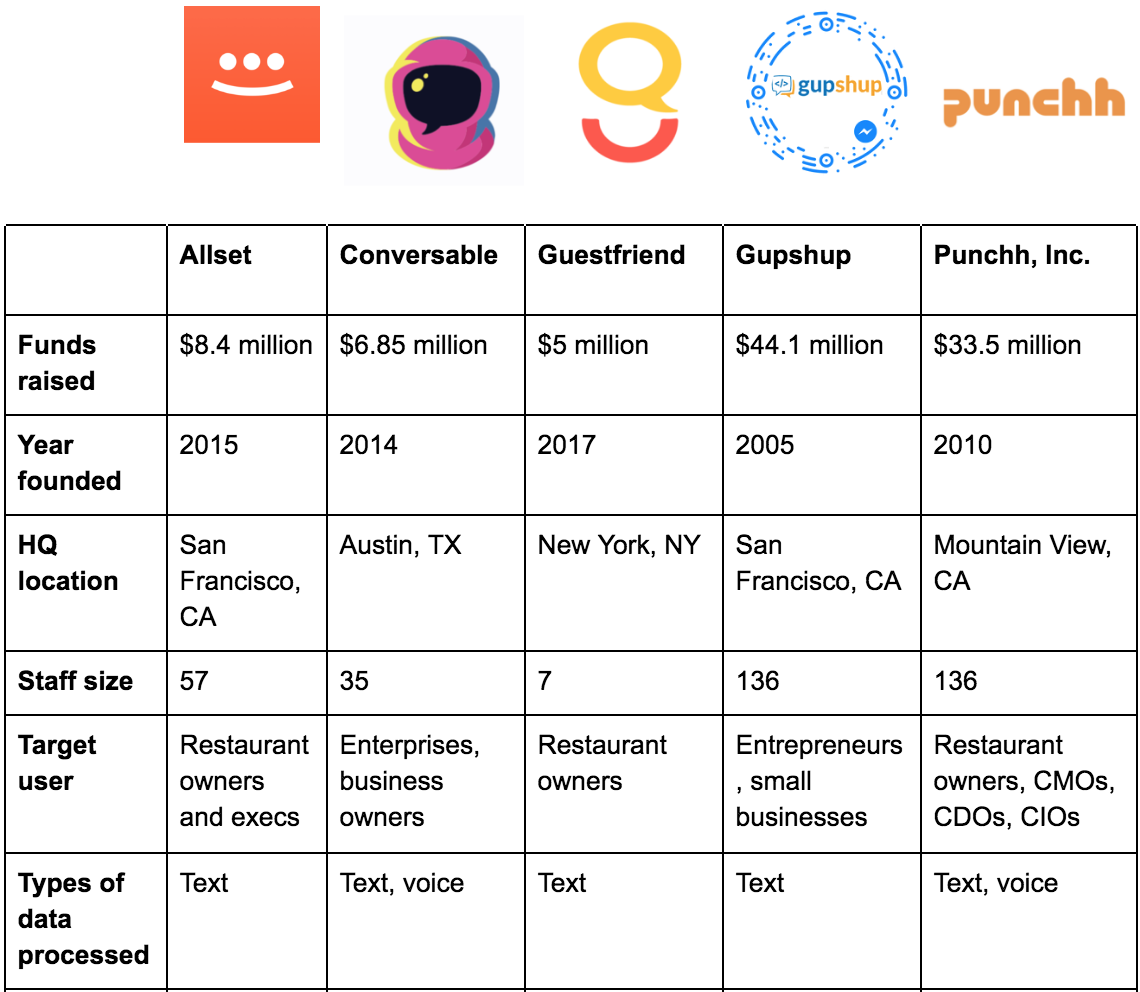
Company logos sourced from LinkedIn. Data collected from Crunchbase, LinkedIn and company websites.
These companies are not indicative of all chatbot applications within this market, but we considered the following observations worth noting:
Allset claims to make the dining experience convenient and fast for users by allowing them to use either the Allset application or the Allset Bot to make reservations, order ahead, plus process payment and tip in advance of the guest(s) arrival at their chosen restaurant. Allset Bot is a designed as a more limited iteration of the full-service application, offering to identify restaurants within a specified zip code, make reservations in advance, and giving the user an option to choose from 10 “hand-curated” menu options.
In its video demo, the chatbot is activated by the user typing “Get Started” and “Order Now.” The bot requests the zip code or street you’d like to search for restaurant options. After confirming the location, users scroll through restaurants, choose one, indicate their time of arrival and whether they’d like to order from the pre-selected options shown in the messaging app.
According to their website, restaurant owners could specifically benefit from this service because the orders are pre-paid and pre-tipped, sent in advance of the customer’s arrival, allow for faster turnaround, and could introduce new clientele that may have not had the time to visit before—assuming the potential customers are limited on time during the work day.
The Allset website does not specify whether or not businesses must opt to be included in a search, nor does it detail from where the app pulls data, like available seating, curated menus or approximate wait time. Order information is sent to the restaurant via app, email, text message or fax, so information could be pulled from these receipts; however, the company doesn’t publically indicate whether this data is aggregated into a report or database. Businesses pay Allset a 12% fee per order, plus a processing fee (2.9% + $0.30). Additionally, there is a specific FAQ section for participating business owners.
Conversable claims to be a SaaS platform for designing, building and distributing AI-enhanced messaging and “voice experiences” across multiple platforms, including Facebook Messenger, Twitter and SMS. As detailed by its co-founder and CEO, Ben Lamm, in a June 2016 VentureBeat article, “Conversable doesn’t make bots, it helps companies better communicate with their customers in the messaging channels where their customers already are.” Clients, including eight restaurant chains featured on their site, work with Conversable to create full conversation designs that allow for transactions to be customized for a particular business model.
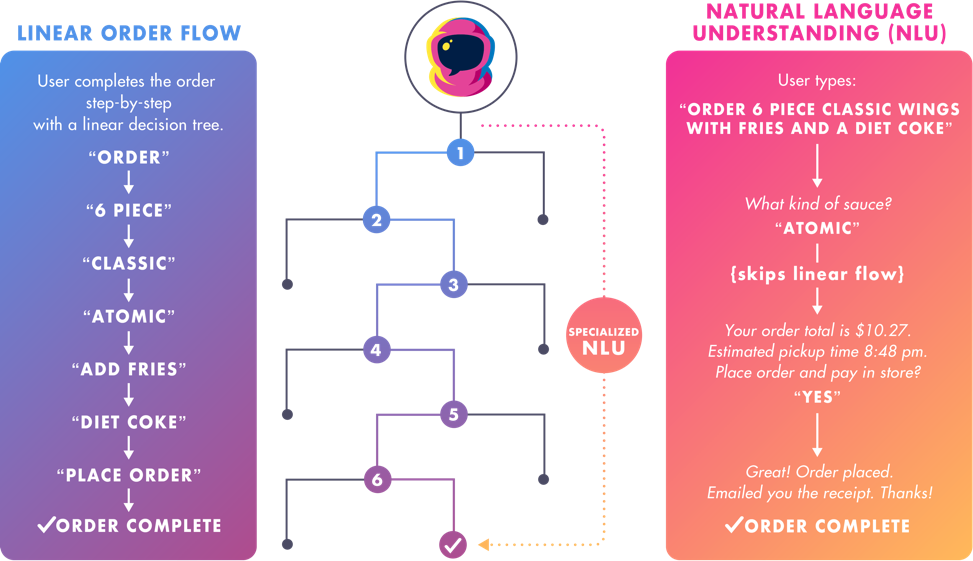
Conversation Flow Model for Conversable, Source: Conversable
For example, TGI Friday’s uses the Conversable platform to allow patrons to make reservations, browse the menu, place orders and search frequently asked questions.
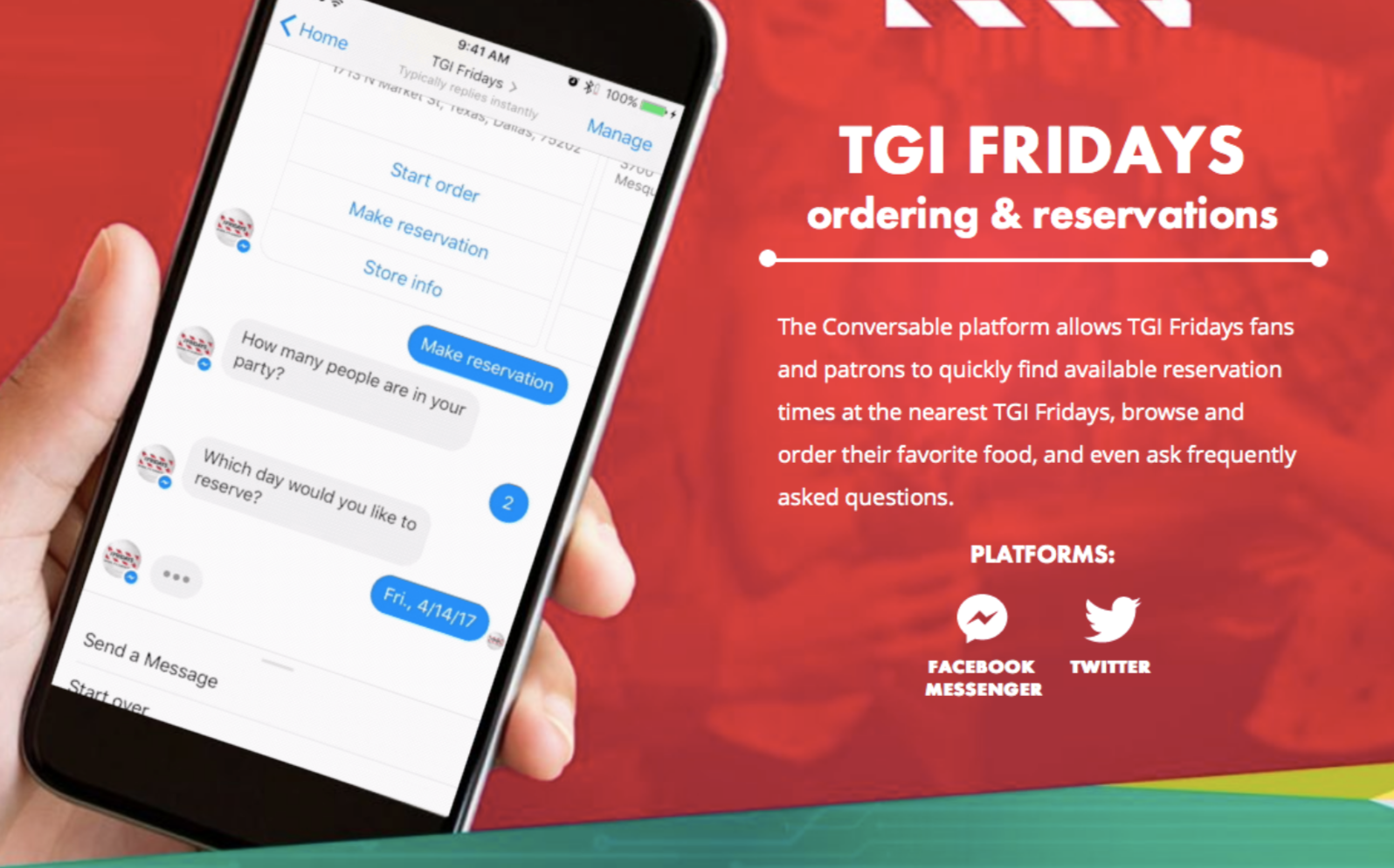
Screenshot of TGI Fridays Application via the Conversable Platform, Source: Conversable
The company uses an interactive content editor (“ICE”) to build complex conversational flows. Visuals on the site show conversation mapping being created “from scratch,” requiring the company to write and input all copy.
However, the Answering Questions Using AI (“AQUA”) platform offered by Conversable allows both customizable responses to be programmed by the company, in addition to using language processing to pull what the bot identifies as relevant information and replying to the inquiring user via chat. The resulting metrics are recorded in a live dashboard for the company and identify popular topics and queries from app users.
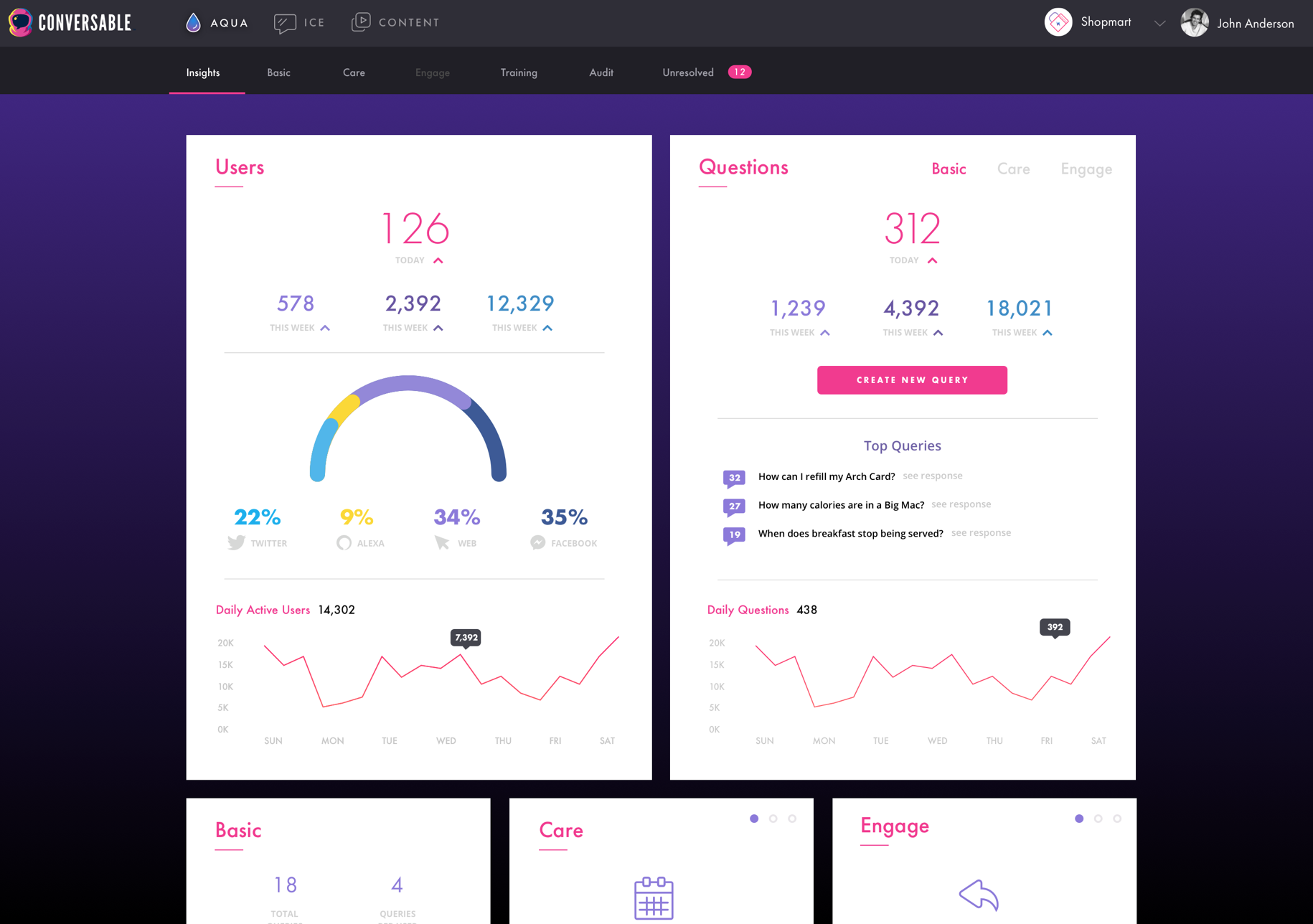
Data Dashboard for Conversable Users, Source: Conversable
Conversable seems to be an in-depth, intensely detailed application appropriate for those businesses who are looking to create personalized messaging and customizable communication flows, rather than those businesses that need a more standardized approach in integrating AI with customer service.
Guestfriend claims to build chatbots for small businesses using publicly available data, such as operating hours and a business’ address, which is automatically sourced by the software. Their primary selling point is a providing a “fully customized bot for any small business.”
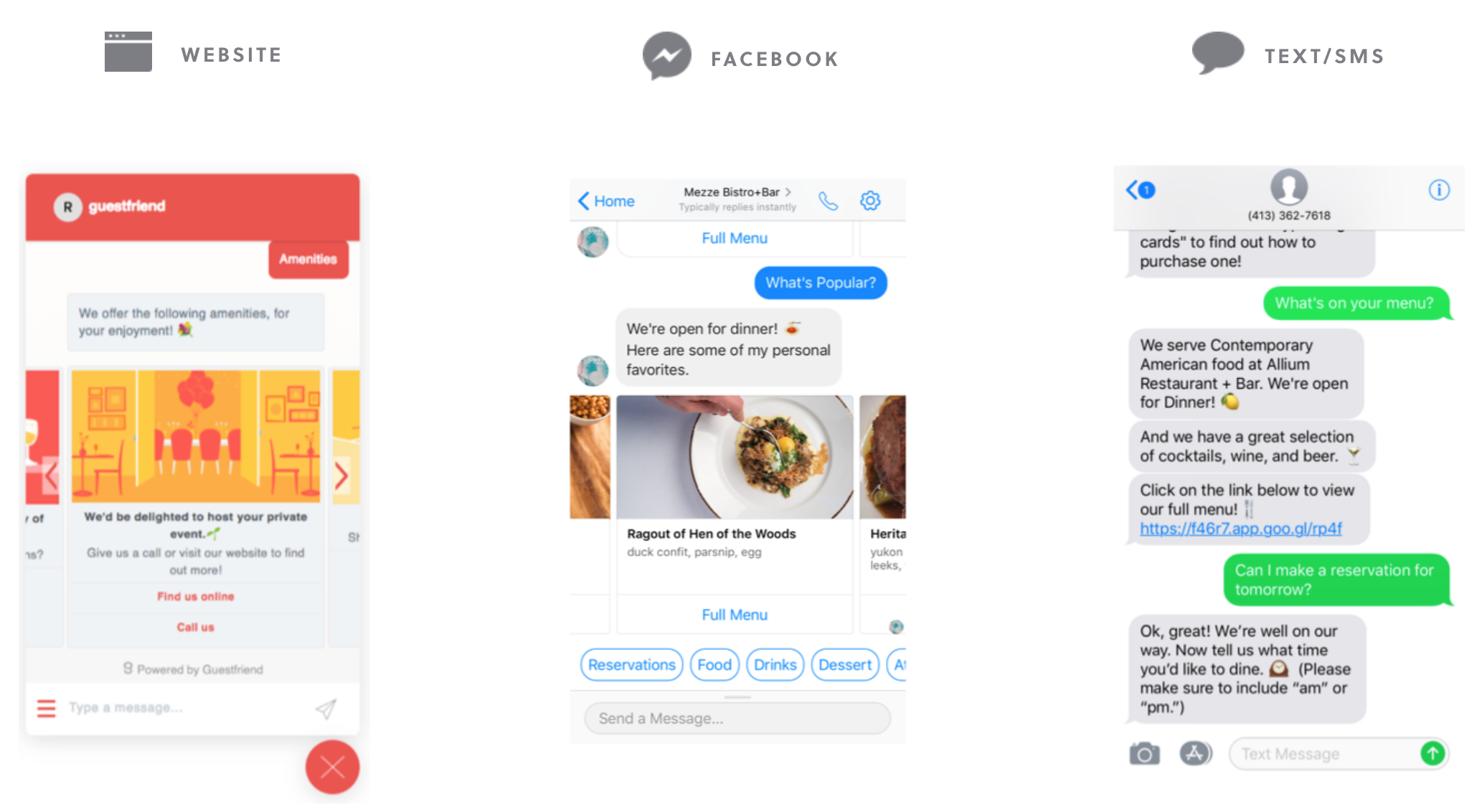
Guestfriend Screenshots Using Various Platforms, Source: Guestfriend
According to founder and CEO Bo Peabody, their primary audience is currently restaurant owners (a “vertical test”), which may be expanded to include the hospitality industry, among others, in the future.
As outlined on their website, restaurateurs enter their business’ name in a search field on the Guestfriend website, a bot is populated with publicly available information, and the chatbot feature can be integrated into both the restaurant’s website and Facebook page with customizable messaging and images.
The final result appears as a chat feature/SMS box. Demo screenshots on the Guestfriend website show conversations between patrons and the bot through Facebook Messenger, the iPhone messages app and the restaurant’s website, integrating emoji, imagery and hyperlinks.
Specific data on user outcomes is not reported on the site; however, it does list four restaurants as case studies, whose websites you can visit to see the app in action. Additionally, Guestfriend does not detail what the business’ interface/backend dashboard looks like and what data is gathered from users.
The Template Bot Builder, created by Gupshup, claims to provide entrepreneurs and small business owners with pre-defined templates using chatbots, connecting them to their target audience(s) and digitizing day-to-day functions. A Business Wire article from November 2, 2016 gives the example of a restaurant owner using a template “that already has food browsing and ordering functionality coded in it.”
Gupshup’s interface features a dashboard of metrics for individual bots, monitoring health and analytics information for the business owner after the completed template has been finished.
The Template Bot Builder for restaurants does not detail whether it processes voice data, although Gupshup uses this technology in other applications. Therefore, we didn’t include voice data within this specific profile. On the restaurant template page, its primary marketing promises were increased customers (i.e., increased orders) and the ability to “easily manage menu updates.” Little detail was given regarding further programming requirements or costs.
Punchh, Inc. claims to be a fully integrated, transformative marketing solution for restaurants’ loyalty programs. According to a Business Wire article published on March 8, 2017, its chatbot technology integrates into existing point-of-sale systems, loyalty and ordering programs and connects to customers via message and voice-based apps, like Facebook Messenger and Alexa.
Punchh positions itself as serving specifically “brick-and-mortar” businesses, and in addition to marketing to restaurants, also serves convenience stores, gas stations and the health and beauty industry. It is designed with an “end-to-end application lifecycle” and offers connection to a company’s POS, ordering, and email systems via APIs and pre-built integrations.
The company reports a 50% increased frequency in [customer] visits and a 20% increase in customer spend, although no source attribution and further data are paired with these claims. Additionally, little information is given about the design and customization process for the participating restaurant(s).
Chatbots processing both text and voice data have the capability of creating unique, immediate interactions between companies and their customers; text data processing is a standard feature in these applications, while voice recognition software seems to be adopted as an enticing, but secondary capability.
Providing further video demos and data to potential customers, especially for those businesses who are looking to make a sizeable investment (relative to their budget) in this technology, could go a long way in transforming public perception of chatbots’ use in customer service and sales from one of hype to one of necessity.
Smaller restaurant conglomerates may view AI technology of this kind as superfluous given the small amount of hard data that accompanies these applications. We suspect that larger restaurant giants with existing tech infrastructure and high volumes of customer data are most likely to take advantage of these technologies in the near term.
An app like Conversable would require high data volumes within a company, as its many functions require personalization and custom copy. Applications that source some publicly available information, like Guestfriend, may be more attractive to restaurants/companies with less need for customized information and input, though it’s unclear as to how transferrable different customer requests and replies are from company to company.
Finally, these applications approach their target audience through various approaches (templates, custom communication plans, automatic population of publicly available data); more research and data collection is necessary to determine which of these methods is preferred by different sectors of the restaurant industry. Making chatbots and AI useable and accessible to non-data scientists is no easy task, and this level of access will be extremely important in the competition in the market for these applications.
Article Source: https://emerj.com/ai-application-comparisons/restaurant-chatbots-comparing-5-current-applications/
According to the 2017 US Mobile Consumer Report, while “more than half of consumers have yet to see a [chatbot],” 65% would be fully comfortable engaging with a company via chatbot; Vibes, the producer of the report, attributes this to a need for immediacy, as well as the less “intrusive” nature of avoiding human customer service representatives.
While this assertion cannot be fully verified, the growing number of mobile applications used to improve the customer experience is evidence that apps like these should be further monitored as potentially profitable resources for companies looking to provide a more personal experience for their target audience(s).
Over the last year we’ve examined chatbot use cases in healthcare and other sectors; in this article, we have organized five companies targeting restaurant owners, using the same seven quantifiable factors (e.g., funds raised, target user, staff size, etc.) to profile several applications that are gaining traction.
These companies are not ranked, but rather presented as individual entities in alphabetical order.
We’ll conclude by discussing the potential value in connecting with customers via mobile devices and future implications of these applications.
A Comparison of Current Restaurant Industry Chatbot Applications
Company logos sourced from LinkedIn. Data collected from Crunchbase, LinkedIn and company websites.
These companies are not indicative of all chatbot applications within this market, but we considered the following observations worth noting:
- Two of these five companies process both text and voice data; these companies have been active for 4+ years, but there is no direct correlation between higher amounts of funding and the ability to process both text and voice data.
- All featured companies are based in the United States. Trends and demands may be unique to the country and do not give a global perspective on the development of chatbots for the restaurant industry.
- The range of longevity, staff size, and funds raised among these companies is indicative of the nascent state of the applications in this space. There are no entrenched players – and to a large degree – the ROI of these technologies has yet to be fleshed out in full.
Allset
- Total funds raised: $8.4 million
- Year founded: 2015
- HQ location: San Francisco, California
- Number of employees: 57
- Target user: Restaurant owners, busy executives
- Type(s) of data processed: Text
- Estimated number of current users: Unspecified
Allset claims to make the dining experience convenient and fast for users by allowing them to use either the Allset application or the Allset Bot to make reservations, order ahead, plus process payment and tip in advance of the guest(s) arrival at their chosen restaurant. Allset Bot is a designed as a more limited iteration of the full-service application, offering to identify restaurants within a specified zip code, make reservations in advance, and giving the user an option to choose from 10 “hand-curated” menu options.
In its video demo, the chatbot is activated by the user typing “Get Started” and “Order Now.” The bot requests the zip code or street you’d like to search for restaurant options. After confirming the location, users scroll through restaurants, choose one, indicate their time of arrival and whether they’d like to order from the pre-selected options shown in the messaging app.
According to their website, restaurant owners could specifically benefit from this service because the orders are pre-paid and pre-tipped, sent in advance of the customer’s arrival, allow for faster turnaround, and could introduce new clientele that may have not had the time to visit before—assuming the potential customers are limited on time during the work day.
The Allset website does not specify whether or not businesses must opt to be included in a search, nor does it detail from where the app pulls data, like available seating, curated menus or approximate wait time. Order information is sent to the restaurant via app, email, text message or fax, so information could be pulled from these receipts; however, the company doesn’t publically indicate whether this data is aggregated into a report or database. Businesses pay Allset a 12% fee per order, plus a processing fee (2.9% + $0.30). Additionally, there is a specific FAQ section for participating business owners.
Conversable
- Total funds raised: $6.85 million
- Year founded: 2014
- HQ location: Austin, Texas
- Number of employees: 35
- Target user: Enterprises, business owners
- Type(s) of data processed: Text, voice
- Estimated number of current users: Unspecified
Conversable claims to be a SaaS platform for designing, building and distributing AI-enhanced messaging and “voice experiences” across multiple platforms, including Facebook Messenger, Twitter and SMS. As detailed by its co-founder and CEO, Ben Lamm, in a June 2016 VentureBeat article, “Conversable doesn’t make bots, it helps companies better communicate with their customers in the messaging channels where their customers already are.” Clients, including eight restaurant chains featured on their site, work with Conversable to create full conversation designs that allow for transactions to be customized for a particular business model.
Conversation Flow Model for Conversable, Source: Conversable
For example, TGI Friday’s uses the Conversable platform to allow patrons to make reservations, browse the menu, place orders and search frequently asked questions.
Screenshot of TGI Fridays Application via the Conversable Platform, Source: Conversable
The company uses an interactive content editor (“ICE”) to build complex conversational flows. Visuals on the site show conversation mapping being created “from scratch,” requiring the company to write and input all copy.
However, the Answering Questions Using AI (“AQUA”) platform offered by Conversable allows both customizable responses to be programmed by the company, in addition to using language processing to pull what the bot identifies as relevant information and replying to the inquiring user via chat. The resulting metrics are recorded in a live dashboard for the company and identify popular topics and queries from app users.
Data Dashboard for Conversable Users, Source: Conversable
Conversable seems to be an in-depth, intensely detailed application appropriate for those businesses who are looking to create personalized messaging and customizable communication flows, rather than those businesses that need a more standardized approach in integrating AI with customer service.
Guestfriend
- Total funds raised: $5 million
- Year founded: 2017
- HQ location: New York, New York
- Number of employees: 7
- Target user: Restaurant owners
- Type(s) of data processed: Text
- Estimated number of current users: Unspecified
Guestfriend claims to build chatbots for small businesses using publicly available data, such as operating hours and a business’ address, which is automatically sourced by the software. Their primary selling point is a providing a “fully customized bot for any small business.”
Guestfriend Screenshots Using Various Platforms, Source: Guestfriend
According to founder and CEO Bo Peabody, their primary audience is currently restaurant owners (a “vertical test”), which may be expanded to include the hospitality industry, among others, in the future.
As outlined on their website, restaurateurs enter their business’ name in a search field on the Guestfriend website, a bot is populated with publicly available information, and the chatbot feature can be integrated into both the restaurant’s website and Facebook page with customizable messaging and images.
The final result appears as a chat feature/SMS box. Demo screenshots on the Guestfriend website show conversations between patrons and the bot through Facebook Messenger, the iPhone messages app and the restaurant’s website, integrating emoji, imagery and hyperlinks.
Specific data on user outcomes is not reported on the site; however, it does list four restaurants as case studies, whose websites you can visit to see the app in action. Additionally, Guestfriend does not detail what the business’ interface/backend dashboard looks like and what data is gathered from users.
Gupshup
- Total funds raised: $44.1 million
- Year founded: 2005
- HQ location: San Francisco, California
- Number of employees: 136
- Target user: Entrepreneurs, small businesses
- Type(s) of data processed: Text
- Estimated number of current users: Unspecified
The Template Bot Builder, created by Gupshup, claims to provide entrepreneurs and small business owners with pre-defined templates using chatbots, connecting them to their target audience(s) and digitizing day-to-day functions. A Business Wire article from November 2, 2016 gives the example of a restaurant owner using a template “that already has food browsing and ordering functionality coded in it.”
Gupshup’s interface features a dashboard of metrics for individual bots, monitoring health and analytics information for the business owner after the completed template has been finished.
The Template Bot Builder for restaurants does not detail whether it processes voice data, although Gupshup uses this technology in other applications. Therefore, we didn’t include voice data within this specific profile. On the restaurant template page, its primary marketing promises were increased customers (i.e., increased orders) and the ability to “easily manage menu updates.” Little detail was given regarding further programming requirements or costs.
Punchh, Inc.
- Total funds raised: $33.5 million
- Year founded: 2010
- HQ location: Moutain View, California
- Number of employees: 136
- Target user: Restaurant owners, CMOs, CDOs, CIOs
- Type(s) of data processed: Text, voice
- Estimated number of current users: Unspecified
Punchh, Inc. claims to be a fully integrated, transformative marketing solution for restaurants’ loyalty programs. According to a Business Wire article published on March 8, 2017, its chatbot technology integrates into existing point-of-sale systems, loyalty and ordering programs and connects to customers via message and voice-based apps, like Facebook Messenger and Alexa.
Punchh positions itself as serving specifically “brick-and-mortar” businesses, and in addition to marketing to restaurants, also serves convenience stores, gas stations and the health and beauty industry. It is designed with an “end-to-end application lifecycle” and offers connection to a company’s POS, ordering, and email systems via APIs and pre-built integrations.
The company reports a 50% increased frequency in [customer] visits and a 20% increase in customer spend, although no source attribution and further data are paired with these claims. Additionally, little information is given about the design and customization process for the participating restaurant(s).
Concluding Thoughts on Restaurant Chatbots
Further research is necessary to determine the conversion rate of customer interactions with bots to increased sales and brand awareness. While each of the companies featured here promise positive outcomes and ROI for participating restaurants, little to no data is presented to back up these claims. As a caveat, ROI may be difficult to objectively measure for those well-established enterprises and restaurants that already have high brand awareness – and it’s unclear if the novelty appeal of new applications could skew the future ROI of these applications one way or another.Chatbots processing both text and voice data have the capability of creating unique, immediate interactions between companies and their customers; text data processing is a standard feature in these applications, while voice recognition software seems to be adopted as an enticing, but secondary capability.
Providing further video demos and data to potential customers, especially for those businesses who are looking to make a sizeable investment (relative to their budget) in this technology, could go a long way in transforming public perception of chatbots’ use in customer service and sales from one of hype to one of necessity.
Smaller restaurant conglomerates may view AI technology of this kind as superfluous given the small amount of hard data that accompanies these applications. We suspect that larger restaurant giants with existing tech infrastructure and high volumes of customer data are most likely to take advantage of these technologies in the near term.
An app like Conversable would require high data volumes within a company, as its many functions require personalization and custom copy. Applications that source some publicly available information, like Guestfriend, may be more attractive to restaurants/companies with less need for customized information and input, though it’s unclear as to how transferrable different customer requests and replies are from company to company.
Finally, these applications approach their target audience through various approaches (templates, custom communication plans, automatic population of publicly available data); more research and data collection is necessary to determine which of these methods is preferred by different sectors of the restaurant industry. Making chatbots and AI useable and accessible to non-data scientists is no easy task, and this level of access will be extremely important in the competition in the market for these applications.
Article Source: https://emerj.com/ai-application-comparisons/restaurant-chatbots-comparing-5-current-applications/
Monday, 30 September 2019
Chatbots in Restaurants: Redefining Customer Experience
Chatbots can be programmed to carry out a myriad of tasks. Can they help your brand?
Chatbots can free your staff up for other tasks.
Gartner predicts that by 2020, a whopping 85 percent of enterprise-customer relationships will be managed without human interactions. Surveys show that 89 percent of consumers opt to engage with businesses through text and 64 percent of consumers that communicate with businesses via text leave with a positive impression.Clearly, we are not far from the time where majority of interactions will be automated completely given that conversational AI/intelligent chatbots are playing a crucial role in almost every industry.
With chatbots becoming mainstream, several industries are utilizing them as they offer greater and less intrusive opportunities when it comes to customer engagement (esp. hyper connected millennials). It is only a matter of time before chatbots in restaurants make their way to the forefront. Designed to communicate in a meaningful manner with customers, chatbots can be integrated with any interface (Facebook, Slack or Telegram to name a few). For example, the pizza bot from Domino’s takes delivery orders directly from Facebook Messenger with a mere emoji.
Given that customer retention and loyalty is at the core of any service-based business, it is paramount for restaurants to fulfill and exceed expectations when it comes to guest service. Everything from running marketing campaigns, their website to online and offline services is a means to attaining the very goal of impeccable service. However, be it ordering food, making a reservation or even getting recommendations, it is impossible for service staff to meet everyone’s standards consistently, which can result in a negative brand image for the restaurant.
With chatbots, your customers no longer need to make a call to reserve a table, wait for staff to attend to them or wait in line for tables to free up. Restaurants don’t need to have an exclusive service executive for the customers either. Bots can be programmed to carry out a myriad of tasks ranging from answering FAQs, making a reservation, ordering food or processing payment. The bot can carry out these tasks in manner similar to a service executive, difference being—it can execute round the clock with zero downtime.
Here’s an interesting scenario:
The customer uses the chatbot to order a steak. Post assessing the order, an intelligent chatbot can offer suggestions on pairing that steak with a red wine.
Additionally, if the customer is looking to simply order wine along with their food, the chatbot shows recommendations on the different kind of wines available with the restaurant.
Customer then selects the wine of his/her choice and places the follow up order. If this is an order for delivery, the payment can be processed through the bot itself.
Restaurants can use chatbots for similar meal pairings or recommendations—this not only engages the customer with your brand but also drives revenue. The best part? You don’t have to ask your customers to download the chatbot like an app (it can be integrated with the channel of your choice). These bots also keep the conversation ongoing. Whether it is by asking relevant questions, sharing interesting trivia or even cracking the occasional joke just like a friend would on Messenger.
Furthermore, chatbots in restaurants need to be perfectly synchronized with the marketing and other customer oriented efforts. Bots can parallel serve as an intelligence-gathering tool which assists a restaurant in understanding their customers. With customer contact details, past orders, preferred method of payment etc., the chatbot in restaurant can not only personalize a customers experience but also reward/incentivize loyal customers in order to increase repeat business—all through a well designed chatbot conversation.
That apart, while the staff focuses on preparing and serving food, chatbots can engage with the customers by answering questions related to open and close times, reward points or whether if the restaurant is open on a public holiday. The use cases of chatbot in restaurants rely heavily on the kind of experience restaurants want to offer their visitors.
For millennials, the generation that actively prefers not speaking with others, they can be the perfect fit as they are the ones who, apart from food, also expect a digital experience. This is where restaurants need to evolve by understanding modern day customer behaviors and expectations with the advent of digital technology.
Across multiple industries, capturing and retaining customer interest and business through AI powered technologies has now become a priority. An estimated 2 billion messages have been sent by 60 million businesses on Facebook messenger alone on a monthly basis. This shows that there is a huge opportunity for chatbot in restaurants when it comes to enhancing customer engagement and thereby opening the doors to a broader hyper connected demographic.
Hotels have already started integrating chatbots in their operational processes and noticed good ROI. Restaurants that take the leap in incorporating chatbots will be sure to see a growing customer base and more cost-effectiveness, which will ultimately be conducive to overall growth and revenue generation.
Mitul Makadia is founder of Maruti Techlabs and a true technophile. With his industry experience, he has rapidly developed Maruti Techlabs in specialized services like Chatbot Development, Artificial Intelligence, Natural Language Processing and Machine Learning. Makadia has considerable expertise in Chatbot Development and NLP.
Article Source: https://www.qsrmagazine.com/outside-insights/chatbots-restaurants-redefining-customer-experience
Friday, 27 September 2019
Josh Thomas: Reviving the Restaurant Industry, A Chatbot Story
We know the story all too well. Amazing restaurant opens up, locals rave and pack the venue every weekend, and a year later? They close their doors. It’s a story all too common. In fact, 80% of restaurants and bars are out of business within 5 years. (Business Insider)
Who would have thought? After all, on paper, they had it all right. They were active on social media, hosted events frequently, were inundated with local press, and treated every single customer like they were their own special star. Alas, all of the limited-release craft brews, hand-cut cocktail ice, and artisanal charcuterie meats in the world couldn’t save them.
Bypassing the ‘why’ (ahem, Millennials & Uber - I’m guilty also), we have a serious issue- people just aren’t showing up to restaurants as frequently. As Sam Wynne, our client & owner of BrainDead Brewing in Dallas, TX puts it-
“a few years ago it was all about getting a handshake at the front door, but now you have to get that first handshake digitally.” — Sam Wynne, BrainDead Brewing
Some restaurants are downright awful. For them, it’s only a matter of time. But for those who aren’t? One of my favorite spots in Dallas for Tacos and Old Fashioneds (don’t judge my taste buds, bud) was Victor Tangos. They closed this year after a decade of stellar service. This is a prime example of a great venue that provided immense value, but just couldn’t keep up with the times.
Now, let’s get to the meat of this post. I’m going to share two of the strategies we are using to help restaurants, bars, breweries, and others push through the hard times.
The Benefit
Chatbots can be used for many things. At Botsmith AI, we are leveraging them to build brand awareness, increase attendance, and distribute information on events & specials for our restaurant clients. Additionally, we are using them to thank visitors to ensure the best customer service.
It’s like email on steroids. Done right, the benefit here is obvious & incredibly potent.
A Few Strategies to Start
Quick Note on Choosing a Platform
I’ll cover this briefly as others have already written exhaustive lists on the pros and cons of each chatbot platform. For restaurateurs who want to go this alone, I highly recommend using ManyChat. It is incredibly visual and intuitive, and easier to manage than most platforms. That said, there are other great platforms out there, so do your research and pick the one you feel most comfortable with.
The Facebook Comments Growth Tool
Growth tools are the bread and butter of what makes chatbots great. We won’t go into a ton of detail here (again, tons of articles about these) but here is our favorite:
Facebook Comments GT Example: Run an organic page post or paid ad promoting an irresistible special. Ask users to comment on the feed to be sent a coupon. Create the tool + sequence in ManyChat. The bot automatically sends the opt-in + coupon, and informs them they will get some messages every now and then. Don’t forget to ask them to share with friends!
BrainDead Brewing Beer List Messenger QR Code
Using Messenger QR Codes
Here is a hot tip for you, and something we are doing at BrainDead Brewing. We are printing Messenger QR codes on menus & stickers, linked directly to the beer list. Now, instead of patrons getting up to read chalkboards, they can scan the code in Messenger and read the updated list on their phones.
The benefit here is that they become subscribers. The next day, you can thank them for their visit via Messenger, ask how their visit was, and welcome them back in. Bonus points? Give them a coupon to come back in the following week and thank them personally when they do.
P.S. If you want to see BrainDead Brewing’s Messenger QR Growth Tool, just open the Messenger app, go to the camera and hold your finger on the screen to scan the image above! Or Click Here to see the Welcome Sequence.
Final Note
Restaurateurs, you’ve got it rough right now, but we are all appreciative of your hard work, and for bringing our communities together with great food, masterfully crafted cocktails, and cold brews. My hope is this helps many of you keep your businesses running strong so I can continue stuffing my fat face.
If I can help, or if you would like us to build a bot for you, please shoot me a message!
Send Josh a Note on Messenger
Cheers to your success,
-Josh
Article Source: https://chatbotsmagazine.com/reviving-the-restaurant-industry-a-chatbot-story-cbbf77a3b938
Who would have thought? After all, on paper, they had it all right. They were active on social media, hosted events frequently, were inundated with local press, and treated every single customer like they were their own special star. Alas, all of the limited-release craft brews, hand-cut cocktail ice, and artisanal charcuterie meats in the world couldn’t save them.
Bypassing the ‘why’ (ahem, Millennials & Uber - I’m guilty also), we have a serious issue- people just aren’t showing up to restaurants as frequently. As Sam Wynne, our client & owner of BrainDead Brewing in Dallas, TX puts it-
“a few years ago it was all about getting a handshake at the front door, but now you have to get that first handshake digitally.” — Sam Wynne, BrainDead Brewing
Some restaurants are downright awful. For them, it’s only a matter of time. But for those who aren’t? One of my favorite spots in Dallas for Tacos and Old Fashioneds (don’t judge my taste buds, bud) was Victor Tangos. They closed this year after a decade of stellar service. This is a prime example of a great venue that provided immense value, but just couldn’t keep up with the times.
Now, let’s get to the meat of this post. I’m going to share two of the strategies we are using to help restaurants, bars, breweries, and others push through the hard times.
The Benefit
Chatbots can be used for many things. At Botsmith AI, we are leveraging them to build brand awareness, increase attendance, and distribute information on events & specials for our restaurant clients. Additionally, we are using them to thank visitors to ensure the best customer service.
It’s like email on steroids. Done right, the benefit here is obvious & incredibly potent.
A Few Strategies to Start
Quick Note on Choosing a Platform
I’ll cover this briefly as others have already written exhaustive lists on the pros and cons of each chatbot platform. For restaurateurs who want to go this alone, I highly recommend using ManyChat. It is incredibly visual and intuitive, and easier to manage than most platforms. That said, there are other great platforms out there, so do your research and pick the one you feel most comfortable with.
The Facebook Comments Growth Tool
Growth tools are the bread and butter of what makes chatbots great. We won’t go into a ton of detail here (again, tons of articles about these) but here is our favorite:
Facebook Comments GT Example: Run an organic page post or paid ad promoting an irresistible special. Ask users to comment on the feed to be sent a coupon. Create the tool + sequence in ManyChat. The bot automatically sends the opt-in + coupon, and informs them they will get some messages every now and then. Don’t forget to ask them to share with friends!
BrainDead Brewing Beer List Messenger QR Code
Using Messenger QR Codes
Here is a hot tip for you, and something we are doing at BrainDead Brewing. We are printing Messenger QR codes on menus & stickers, linked directly to the beer list. Now, instead of patrons getting up to read chalkboards, they can scan the code in Messenger and read the updated list on their phones.
The benefit here is that they become subscribers. The next day, you can thank them for their visit via Messenger, ask how their visit was, and welcome them back in. Bonus points? Give them a coupon to come back in the following week and thank them personally when they do.
P.S. If you want to see BrainDead Brewing’s Messenger QR Growth Tool, just open the Messenger app, go to the camera and hold your finger on the screen to scan the image above! Or Click Here to see the Welcome Sequence.
Final Note
Restaurateurs, you’ve got it rough right now, but we are all appreciative of your hard work, and for bringing our communities together with great food, masterfully crafted cocktails, and cold brews. My hope is this helps many of you keep your businesses running strong so I can continue stuffing my fat face.
If I can help, or if you would like us to build a bot for you, please shoot me a message!
Send Josh a Note on Messenger
Cheers to your success,
-Josh
Article Source: https://chatbotsmagazine.com/reviving-the-restaurant-industry-a-chatbot-story-cbbf77a3b938
Thursday, 26 September 2019
Ish Jindal: A Comprehensive Guide for using Chatbots in your Restaurant
Dominos, TGIF and Pizza Hut all have chatbots and you can too.
Early last year, a high-level Uber executive named Chris Messina claimed that 2016 would be the year of conversational commerce. If you don’t know what that means, then you are normal.
But if you work in the restaurant industry, you should definitely change that.
Silicon Valley has an uncanny habit of creating new tech trends that turn industries on their heads. Conversational commerce is one of those tech trends and the restaurant industry is one of its first targets.
This is your comprehensive guide on why this is the case and how you can get ahead of the curve.
Here’s how this is article is structured. In the sections 1 and 2, I am going to explain what conversational commerce is and why there is growing buzz around it in the tech space. Skip to section 3 if you already know all of this. In section 3, I will discuss what this new tech trend means for the restaurant industry in particular. Finally, section 4 will give you resources you need to get started.
Enjoy!
1. What is conversational commerce?
The term sounds jargony at first, but when you break it down to its fundamental parts, it is fairly basic. Conversational commerce is the process of conducting business by talking to someone. The vast majority of business conducted in human history has been conversational commerce.
If you have ever gone to a corner store, pharmacy or a shopping mall and talked to any of the store attendants you have engaged in conversational commerce.
It can even occur over distances. Ever ordered food through the phone? Or chatted with someone to buy something from them? Those count as conversational commerce as well.
2. Why it matters
There are three reasons you should care about conversational commerce:
Reason 1: The growing popularity of messaging apps.
Think about all the apps you use everyday. A messaging app surely figures near the top of the list.
Unsurprisingly, this is the case for most people with a smartphone. The chart below shows the number of people using the top 4 messaging apps vs the number of people using the top 4 social media apps over time.
In 2015, the top messaging apps overtook the top social network apps in usage by a wide margin.
Implication 1: Your customers are devoting hours of their attention to conversational apps.
Implication 2: Your customers are used to the chat interface because they use it on a daily basis (you will find out why this is important in Section 3).
Reason 2: The proliferation of platforms that allow customer interaction.
The potential of conversational commerce has not gone unnoticed by companies in the space. In the year after Messina’s statement:
Facebook introduced its Messenger bot platform which allows Facebook pages to create automated chat experiences with users
Kik, Telegram and Line developed their existing bot platforms further
Viber opened up public accounts for companies to talk to people
iMessage added apps within chats.
Seemingly WhatsApp is the only big chat app missing in action (as an Indian this makes me sad), but even they have announced plans for commercial accounts soon. In fact, they are already doing beta testing of commercial accounts with a few businesses now.
Implication: You can now easily interact with your customers in the apps that they use most.
Reason 3: The Increasing capability of Artificial Intelligence.
Conversational commerce has always been hampered by the need for human labour. We get tired, we can only talk to one person at a time, we get stressed out, and most importantly we need to be paid. This makes us too expensive and slow for certain tasks.
Till recently, the solution has been to get customers to serve themselves. Think about travel booking as an example. We have shifted from a model of asking travel agents to bundle flight and hotel bookings for us, to doing it ourselves using the plethora of online hotel and flight booking sites available at our fingertips.
Why? Because we can instantly book flight tickets and hotel rooms on Expedia for cheaper than any travel agent could afford to charge (There is a great piece explaining this shift better and more in-depth that you should check out if you have the time. Here is the link)
Artificial Intelligence (AI) is slowly enabling us to shift back to a paradigm where the user does less on their own. An ideal AI travel assistant would be able to take your travel requirements and book all the flights and hotels you need in one bundle like a travel agent. Unlike a travel agent though, they could do it instantly like an app and for cheaper because there is no human that needs to be paid sitting at the back. Computers cease to be a tool used to do something yourself and more an assistant that is doing things for you.
Before you get too excited we are still a few years away from such a travel assistant. But the underlying AI technology is becoming cheaper, more advanced and readily available. Google, Facebook and IBM all have AI resources available for anyone to use right now.
Implication: Conversational Commerce is becoming cheaper to engage in.
A Quick Note on AI
There are two caveats to consider when thinking about AI. First, AI as it is currently available is still quite raw.
Second, if you are willing to sacrifice the complexity of the interaction, you do not need AI to create a good and cheap conversational commerce experience.
You’ll find out why conversational commerce is still beneficial without AI in the next section.
3. How can restaurants use this tech?
Restaurants are arguably the pioneers of conversational commerce. One of the only reasons I still use my smartphone to make calls is when I am ordering food. But even this basic use case could stand to be improved significantly by new technology. The primary new channel through which conversational commerce can occur is chatbots.
A chatbot is a piece of software that can respond to a customer’s messages in a chat interface using either AI or pre-programmed rules. The examples we gave above of the AI fail and the hotel booking were both examples of chatbots.
Where can customers find them?
Customers can interact with them in popular messaging apps that support chatbots (FB Messenger, Telegram, Line, Kik) or even on your website.
The most obvious use case for such a technology is for food ordering. Users could use a food ordering chatbot much like they would a phone ordering system except instead of talking to a staff member they chat with the bot.
Another possible use could be a chatbot for taking feedback. Bangalore based food chain Bhukkad uses a conversational feedback form for their delivery orders. You can read more about their experience here or check out the bot that they use over here:
Real-world Examples of Restaurant Chatbots
The three most prominent users of chatbots in the restaurant space are Domino’s, TGI Friday and Pizza Hut. Dominos and Pizzahut use it for food ordering and TGI Friday for making reservations.
What are the advantages of a chatbot?
This is a natural question to ask. All of the examples above could be implemented through an app or a website so why use a bot?
Let’s break it down:
Bots require no extra downloads
Bots have one clear advantage over apps in particular. Customers do not have to download anything extra to use a bot. If you use GrubHub for delivery and a customer has Eat24, the probability that the customer downloads Eat24 just to order from your restaurant is quite low. The average American downloads 1 app per month. In developing market like India, where people have cheaper phones with less memory, the probability becomes lower.
As Cliff Kuang from FastCo Design put it
There’s an enormous amount of friction associated with learning about a new app, downloading it, signing up for it, and then remembering you even have it.
Since users can interact with bots in messaging apps they already have downloaded or in a web browser, the chance of them completing an order goes up.
Chat is mobile optimised
Regular websites don’t fair too much better than apps. While you don’t have to download anything extra to use a website, many websites have a tendency to suck on people’s phones. If they aren’t built correct, they can be slow, clunky and unresponsive. If they aren’t optimised for the phone screen, users can spend ungodly amounts of time pinching and zooming on the screen to figure out what is going on. Even if you do invest enough money to build a good website, the user’s internet connection could give out reducing your beautifully designed site to a continuous stream of loading screens.
Chatbots don’t face these problems. First, chat as an interface was designed with the mobile user in mind. So whether you implement it through an app or your website, the user can easily see what is exactly going on at all times.
Second, if you build a bot within a messaging app like FB Messenger, you can trust Facebook’s highly paid and highly trained UI team to make the interface responsive.
Finally, since each chat interaction happens on a single page the customer never needs to interact with a load screen.
The chat interface is familiar
Every website and app looks different. Even if you convince a user to use one of them, they have to learn how to navigate their way around. Look at the Domino’s website and bot again. With the website there is so much happening on the screen you do not know where to click.
With the bot on the other hand, the customer knows exactly what to do. The interface is similar to one they use everyday.
Chat feels more human than apps and websites
When a customer interacts with a bot and an app the two experiences feel very different even if they achieve the same thing. Using an app feels like using a tool to achieve something, while using a bot feels like the computer is assisting you through a process.
Before you start building… (Read this whole section. It is very important)
There are two things to consider before you start building your bot. First, I would think long and hard about what function your bot will serve. Remember that AI technologies are still very raw so the tasks a customer gets done through a bot cannot be too complex. Also, in my personal experience of using bots everyday, I have found that the best bots tend to be those which do one or two tasks really well. Add too many tasks and the user can get easily confused because you have to run through far too many menus. I wrote a whole other piece on this that you should check out for a better understanding (Chris Messina recommended it so I promise it is good).
Second, I would try and figure out which platform you want to build your bot on. This will depend largely on where your customers are. Facebook Messenger is fairly universally used so bot developers tend to gravitate towards it. But if you are in a region where another messaging app is popular then build a bot on that platform (Line, Kik, Telegram, etc).
Also consider a bot on your website as an option. Website bots offer two advantages of their app based counterparts. First, in a lot of developing markets, like India, people do not like using Facebook Messenger because it uses too much data and runs very slowly on most phones. In a case like this, you could build a bot on the preferred messaging app in the region or on your website (this is especially true if WhatsApp is the preferred messaging app in your region because WhatsApp does not support bots). Second, Messenger (and Kik and Telegram) bots all face a discovery issue. People do not know how or where to find them. Your website on the other hand is already getting traffic and people can easily run into them on Google. But be warned, if you make a web-based bot it is harder to send users notifications once they have left the site. This could be a downside if you want to ping your customers with discount coupons over time.
Article Source: https://hellotars.com/blog/restaurant-chatbot-guides/
Early last year, a high-level Uber executive named Chris Messina claimed that 2016 would be the year of conversational commerce. If you don’t know what that means, then you are normal.
But if you work in the restaurant industry, you should definitely change that.
Silicon Valley has an uncanny habit of creating new tech trends that turn industries on their heads. Conversational commerce is one of those tech trends and the restaurant industry is one of its first targets.
This is your comprehensive guide on why this is the case and how you can get ahead of the curve.
Here’s how this is article is structured. In the sections 1 and 2, I am going to explain what conversational commerce is and why there is growing buzz around it in the tech space. Skip to section 3 if you already know all of this. In section 3, I will discuss what this new tech trend means for the restaurant industry in particular. Finally, section 4 will give you resources you need to get started.
Enjoy!
1. What is conversational commerce?
The term sounds jargony at first, but when you break it down to its fundamental parts, it is fairly basic. Conversational commerce is the process of conducting business by talking to someone. The vast majority of business conducted in human history has been conversational commerce.
If you have ever gone to a corner store, pharmacy or a shopping mall and talked to any of the store attendants you have engaged in conversational commerce.
It can even occur over distances. Ever ordered food through the phone? Or chatted with someone to buy something from them? Those count as conversational commerce as well.
2. Why it matters
There are three reasons you should care about conversational commerce:
Reason 1: The growing popularity of messaging apps.
Think about all the apps you use everyday. A messaging app surely figures near the top of the list.
Unsurprisingly, this is the case for most people with a smartphone. The chart below shows the number of people using the top 4 messaging apps vs the number of people using the top 4 social media apps over time.
In 2015, the top messaging apps overtook the top social network apps in usage by a wide margin.
Implication 1: Your customers are devoting hours of their attention to conversational apps.
Implication 2: Your customers are used to the chat interface because they use it on a daily basis (you will find out why this is important in Section 3).
Reason 2: The proliferation of platforms that allow customer interaction.
The potential of conversational commerce has not gone unnoticed by companies in the space. In the year after Messina’s statement:
Facebook introduced its Messenger bot platform which allows Facebook pages to create automated chat experiences with users
Kik, Telegram and Line developed their existing bot platforms further
Viber opened up public accounts for companies to talk to people
iMessage added apps within chats.
Seemingly WhatsApp is the only big chat app missing in action (as an Indian this makes me sad), but even they have announced plans for commercial accounts soon. In fact, they are already doing beta testing of commercial accounts with a few businesses now.
Implication: You can now easily interact with your customers in the apps that they use most.
Reason 3: The Increasing capability of Artificial Intelligence.
Conversational commerce has always been hampered by the need for human labour. We get tired, we can only talk to one person at a time, we get stressed out, and most importantly we need to be paid. This makes us too expensive and slow for certain tasks.
Till recently, the solution has been to get customers to serve themselves. Think about travel booking as an example. We have shifted from a model of asking travel agents to bundle flight and hotel bookings for us, to doing it ourselves using the plethora of online hotel and flight booking sites available at our fingertips.
Why? Because we can instantly book flight tickets and hotel rooms on Expedia for cheaper than any travel agent could afford to charge (There is a great piece explaining this shift better and more in-depth that you should check out if you have the time. Here is the link)
Artificial Intelligence (AI) is slowly enabling us to shift back to a paradigm where the user does less on their own. An ideal AI travel assistant would be able to take your travel requirements and book all the flights and hotels you need in one bundle like a travel agent. Unlike a travel agent though, they could do it instantly like an app and for cheaper because there is no human that needs to be paid sitting at the back. Computers cease to be a tool used to do something yourself and more an assistant that is doing things for you.
Before you get too excited we are still a few years away from such a travel assistant. But the underlying AI technology is becoming cheaper, more advanced and readily available. Google, Facebook and IBM all have AI resources available for anyone to use right now.
Implication: Conversational Commerce is becoming cheaper to engage in.
A Quick Note on AI
There are two caveats to consider when thinking about AI. First, AI as it is currently available is still quite raw.
Second, if you are willing to sacrifice the complexity of the interaction, you do not need AI to create a good and cheap conversational commerce experience.
You’ll find out why conversational commerce is still beneficial without AI in the next section.
3. How can restaurants use this tech?
Restaurants are arguably the pioneers of conversational commerce. One of the only reasons I still use my smartphone to make calls is when I am ordering food. But even this basic use case could stand to be improved significantly by new technology. The primary new channel through which conversational commerce can occur is chatbots.
A chatbot is a piece of software that can respond to a customer’s messages in a chat interface using either AI or pre-programmed rules. The examples we gave above of the AI fail and the hotel booking were both examples of chatbots.
Where can customers find them?
Customers can interact with them in popular messaging apps that support chatbots (FB Messenger, Telegram, Line, Kik) or even on your website.
The most obvious use case for such a technology is for food ordering. Users could use a food ordering chatbot much like they would a phone ordering system except instead of talking to a staff member they chat with the bot.
Another possible use could be a chatbot for taking feedback. Bangalore based food chain Bhukkad uses a conversational feedback form for their delivery orders. You can read more about their experience here or check out the bot that they use over here:
Real-world Examples of Restaurant Chatbots
The three most prominent users of chatbots in the restaurant space are Domino’s, TGI Friday and Pizza Hut. Dominos and Pizzahut use it for food ordering and TGI Friday for making reservations.
What are the advantages of a chatbot?
This is a natural question to ask. All of the examples above could be implemented through an app or a website so why use a bot?
Let’s break it down:
Bots require no extra downloads
Bots have one clear advantage over apps in particular. Customers do not have to download anything extra to use a bot. If you use GrubHub for delivery and a customer has Eat24, the probability that the customer downloads Eat24 just to order from your restaurant is quite low. The average American downloads 1 app per month. In developing market like India, where people have cheaper phones with less memory, the probability becomes lower.
As Cliff Kuang from FastCo Design put it
There’s an enormous amount of friction associated with learning about a new app, downloading it, signing up for it, and then remembering you even have it.
Since users can interact with bots in messaging apps they already have downloaded or in a web browser, the chance of them completing an order goes up.
Chat is mobile optimised
Regular websites don’t fair too much better than apps. While you don’t have to download anything extra to use a website, many websites have a tendency to suck on people’s phones. If they aren’t built correct, they can be slow, clunky and unresponsive. If they aren’t optimised for the phone screen, users can spend ungodly amounts of time pinching and zooming on the screen to figure out what is going on. Even if you do invest enough money to build a good website, the user’s internet connection could give out reducing your beautifully designed site to a continuous stream of loading screens.
Chatbots don’t face these problems. First, chat as an interface was designed with the mobile user in mind. So whether you implement it through an app or your website, the user can easily see what is exactly going on at all times.
Second, if you build a bot within a messaging app like FB Messenger, you can trust Facebook’s highly paid and highly trained UI team to make the interface responsive.
Finally, since each chat interaction happens on a single page the customer never needs to interact with a load screen.
The chat interface is familiar
Every website and app looks different. Even if you convince a user to use one of them, they have to learn how to navigate their way around. Look at the Domino’s website and bot again. With the website there is so much happening on the screen you do not know where to click.
With the bot on the other hand, the customer knows exactly what to do. The interface is similar to one they use everyday.
Chat feels more human than apps and websites
When a customer interacts with a bot and an app the two experiences feel very different even if they achieve the same thing. Using an app feels like using a tool to achieve something, while using a bot feels like the computer is assisting you through a process.
Before you start building… (Read this whole section. It is very important)
There are two things to consider before you start building your bot. First, I would think long and hard about what function your bot will serve. Remember that AI technologies are still very raw so the tasks a customer gets done through a bot cannot be too complex. Also, in my personal experience of using bots everyday, I have found that the best bots tend to be those which do one or two tasks really well. Add too many tasks and the user can get easily confused because you have to run through far too many menus. I wrote a whole other piece on this that you should check out for a better understanding (Chris Messina recommended it so I promise it is good).
Second, I would try and figure out which platform you want to build your bot on. This will depend largely on where your customers are. Facebook Messenger is fairly universally used so bot developers tend to gravitate towards it. But if you are in a region where another messaging app is popular then build a bot on that platform (Line, Kik, Telegram, etc).
Also consider a bot on your website as an option. Website bots offer two advantages of their app based counterparts. First, in a lot of developing markets, like India, people do not like using Facebook Messenger because it uses too much data and runs very slowly on most phones. In a case like this, you could build a bot on the preferred messaging app in the region or on your website (this is especially true if WhatsApp is the preferred messaging app in your region because WhatsApp does not support bots). Second, Messenger (and Kik and Telegram) bots all face a discovery issue. People do not know how or where to find them. Your website on the other hand is already getting traffic and people can easily run into them on Google. But be warned, if you make a web-based bot it is harder to send users notifications once they have left the site. This could be a downside if you want to ping your customers with discount coupons over time.
Article Source: https://hellotars.com/blog/restaurant-chatbot-guides/
Wednesday, 25 September 2019
Tuesday, 24 September 2019
Subscribe to:
Posts (Atom)